The Question Behind the Question
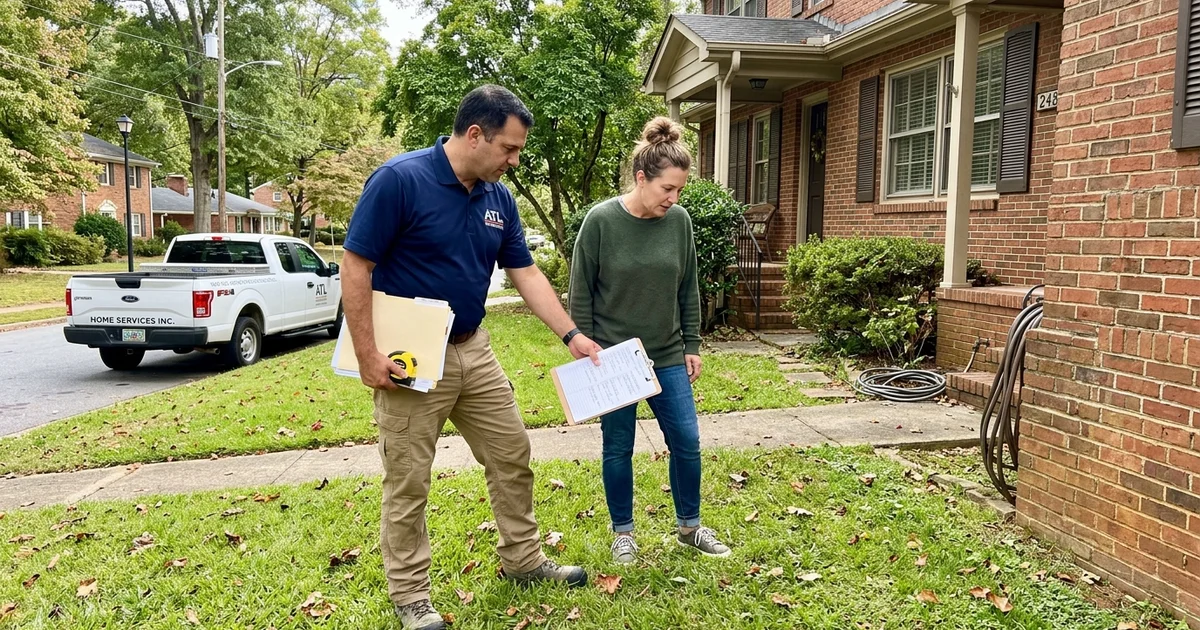
When property owners face the stress of foundation repair vs replacement, they are usually asking how bad the damage truly is. Our honest answer brings most homeowners a massive wave of relief.
Full residential foundation rebuilds are incredibly rare in the metro Atlanta area.
We resolve the overwhelming majority of the severe-looking damage by simply stabilizing what is already there. Understanding why this works comes down to knowing what actually failed.
In nearly every case, the concrete itself is perfectly fine.
“The foundation is often perfectly sound material sitting on ground that will not hold still. Fix the underlying support, and that sound material goes back to doing its job.”
At Basement Waterproofing Atlanta, our structural crews know that the real culprit is the soil underneath the house. Expansive Piedmont red clay, specifically the Cecil soil series common in Georgia, acts like a giant sponge.
This specific clay swells by 10 to 15 percent in volume during wet spring seasons and shrinks rapidly during dry fall spells. Our entire approach to our foundation repair service is built around stopping this exact cycle.
The Mechanics of Stabilization
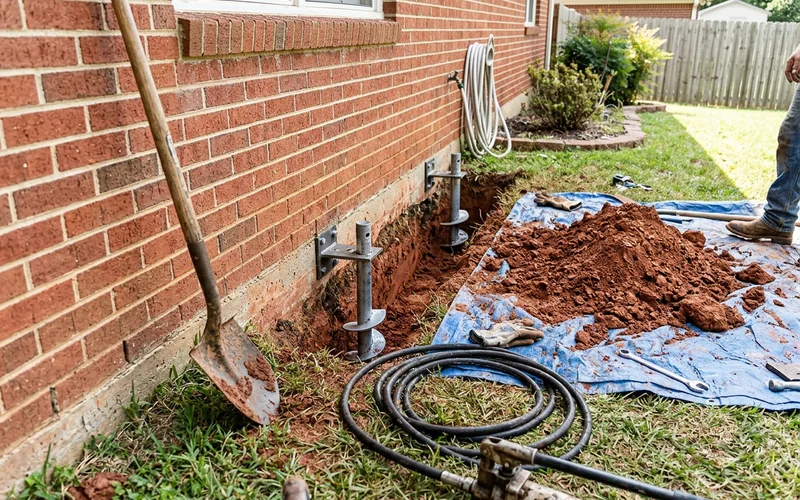
Foundation stabilization means transferring the structural load to stable ground. Our installers advance helical piers or steel push piers past the active clay layer down to deep, load-bearing strata.
Heavy-duty brackets at the footing then move your home’s weight permanently onto them.
Our teams use hydraulic jacking where possible to recover lost elevation, which frequently closes cracks and squares up door frames automatically. Once that transfer is complete, seasonal clay movement no longer reaches the structure.
Comparing the Two Paths
Deciding when to replace foundation materials versus when to stabilize them comes down to the condition of the concrete itself. Our general rule is that if the concrete is crumbling, it needs full replacement, but if it is structurally intact, it just needs stabilization.
Comparing these two paths reveals massive differences in time, disruption, and price.
| Feature | Foundation Stabilization (Piering) | Full Foundation Replacement |
|---|---|---|
| What it fixes | Unstable Piedmont clay soil that cannot support the footing. | A foundation that has failed entirely as a structural material. |
| Typical duration | One to three days on site. | Several weeks of major construction. |
| Average replace foundation cost | Ranges from $4,500 to $12,000 for standard piering. | Costs easily exceed $20,000 to $30,000 due to extensive labor. |
| Disruption | Localized excavation at specific pier installation points only. | House must be temporarily shored, old walls removed, and site rebuilt. |
| Landscaping impact | Minimal and strictly localized, easily restored afterward. | Extensive yard damage requiring a full landscaping reset. |
| How common in Atlanta | The standard outcome for settling homes in Georgia. | Extremely rare for standard residential properties. |
Identifying the Extreme Cases
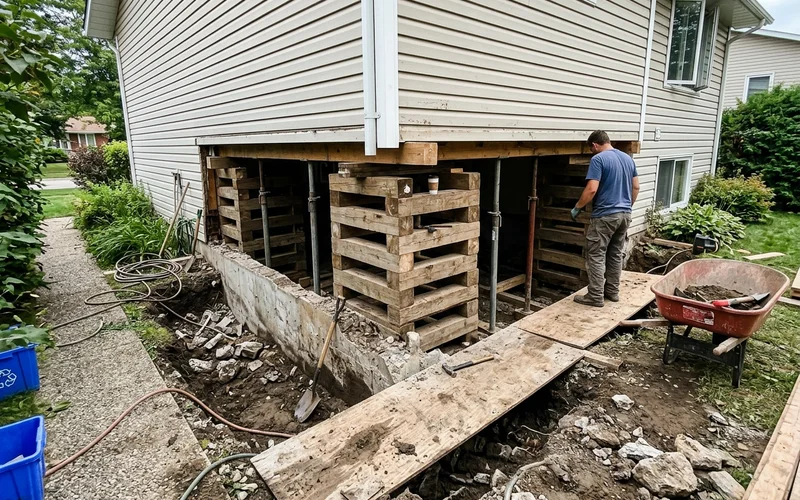
Our crews know exactly when to replace foundation walls, and we only recommend it in a very narrow set of extreme cases. This expensive structural option earns its place when old block walls have physically deteriorated to the point of crumbling.
It also becomes necessary for foundations built on severely inadequate footings. Our engineers know that piering into a weak wall simply moves the point of failure a few feet away.
Driving a standard $1,500 to $3,500 helical pier requires a solid concrete footing to support the bracket’s concentrated lifting load.
The Middle Ground of Foundation Repair
Our structural inspectors frequently encounter a middle category of basement damage. Sometimes the poured walls remain structurally sound but bow inward under heavy lateral soil pressure.
That specific situation requires carbon fiber reinforcement or steel wall anchors rather than vertical piering. Our local data shows these wall stabilization methods typically run between $5,000 and $10,000 for a standard basement.
Property owners rarely keep this middle option on their mental list. This lack of awareness is a major reason why DIY diagnosis tends to skew in the direction of unnecessary worst-case scenarios.
How the Decision Actually Gets Made
The choice between stabilization and replacement gets made through objective, precise measurements rather than visual guesswork. Our process relies on recording hard floor elevations and crack widths to map exactly how much a structure has moved.
An official inspection is a rigorous measuring exercise, not a subjective opinion. Our field teams perform a specific checklist of tests during every site visit to gather this vital data.
A proper structural evaluation includes a few non-negotiable steps.
- Recording floor elevations throughout the house to map exactly where the structure has dropped.
- Checking wall deflection against a laser straight line to detect inward bowing.
- Measuring crack widths to look for physical displacement between the concrete faces.
- Taking precise moisture readings at the footing line to identify hidden drainage issues.
- Assessing the physical condition and crushing strength of the foundation block or poured walls.
Our diagnostics use these five inputs to answer two critical questions. The first question is whether the foundation material is still capable of carrying the home’s load.
The second question is whether the Georgia red clay beneath it can support the footing. We find that for most Atlanta properties, the concrete is fine but the soil is failing, making stabilization the clear choice.
Only when the concrete itself has crumbled does full replacement enter the conversation.
Getting Your Action Plan
Our team advises anyone trying to gauge the severity of their damage to review the signs of foundation problems before booking a visit. This practical resource covers exactly what warning signs to look for inside and outside the home.
Our commitment is that whichever direction the physical assessment points, you get it in writing with the hard measurements behind it. Your zero-obligation inspection includes a few critical deliverables.
- A complete visual assessment of interior and exterior walls.
- Precise floor elevation readings across the main level.
- A clear, written breakdown of the required scope of work.
The person conducting this visit is a certified field inspector rather than a high-pressure salesperson working on commission.
Our primary goal is to help you walk through those objective numbers together to finally settle your foundation repair vs replacement debate. Sitting down with the data is what turns an open-ended panic into a clearly defined, solvable scope of work.
Schedule your free evaluation with us today to protect your home’s structural integrity.