Every homeowner dealing with foundation problems in Atlanta eventually faces the same unsettling question when a door suddenly stops latching or a new crack appears above the window.
These small changes are direct evidence that the heavy clay beneath your footing is actively shifting.
Our team knows that understanding the difference between normal seasonal movement and a structural failure saves you a massive amount of unnecessary stress. Many homeowners ignore early warning signs purely because they do not know what to look for.
We will break down the exact signs of foundation problems, highlight the cosmetic issues you can ignore, and explain the financial impact of waiting. If the damage you find matches the urgent signs on this list, our foundation repair service covers exactly how the stabilization process works.
What Foundation Trouble Actually Looks Like
Our crews see the same distinct patterns of damage across Lawrenceville, Gainesville, and throughout the metro area. You can identify these patterns yourself by knowing exactly where to look. We recommend starting your inspection on the outside of the home.
Exterior Warning Signs in Brick and Block
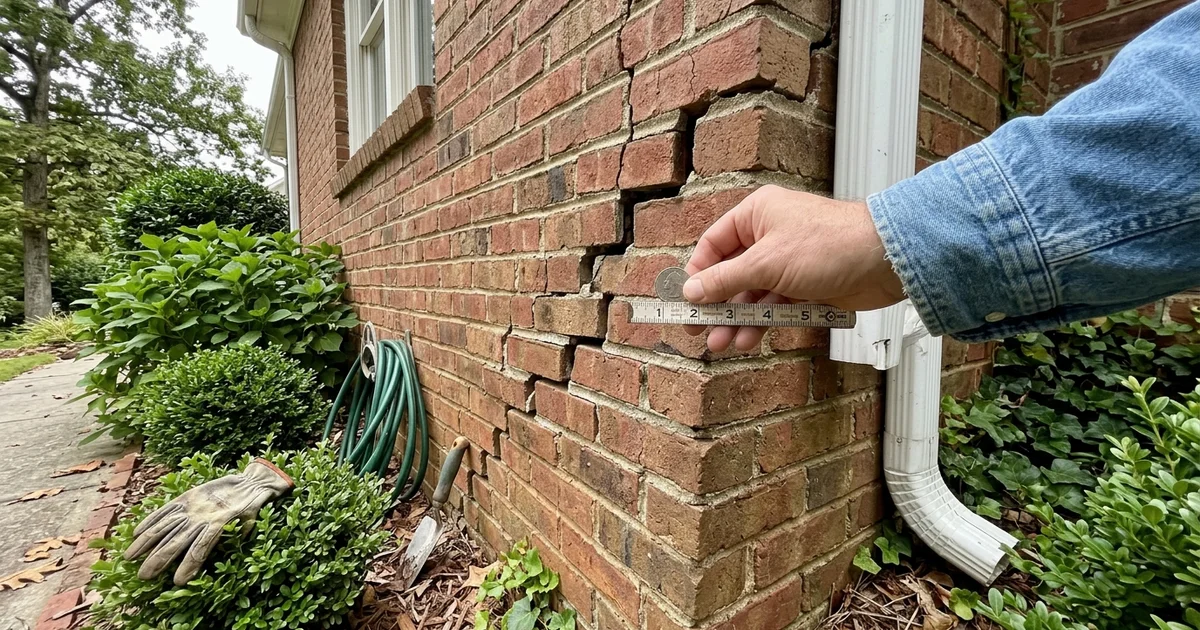
Stair-step cracks climbing diagonally through mortar joints are the single most reliable sign of differential settlement in the Georgia Piedmont region. These cracks appear at corners and above openings because those areas offer the least resistance to being pulled apart.
When you spot cracks in walls, foundation problems are often the root cause. Our structural specialists look for a few critical severity indicators on exterior brickwork:
- Gap width: Any mortar crack wider than a quarter of an inch.
- Flushness: A crack where the two sides of the brick no longer line up evenly.
- Horizontal fractures: A straight crack running across a block basement wall, especially near mid-height.
This specific horizontal fracture pattern indicates lateral soil pressure pushing the wall inward, making it the most urgent structural issue you can find. We use a simple string line pulled tight across the wall to measure exactly how far the block has deflected inward. Modern contractors also use a standard laser level to spot bowing walls before the severe cracks become visible.
Interior Clues: Sticking Doors and Sloping Floors
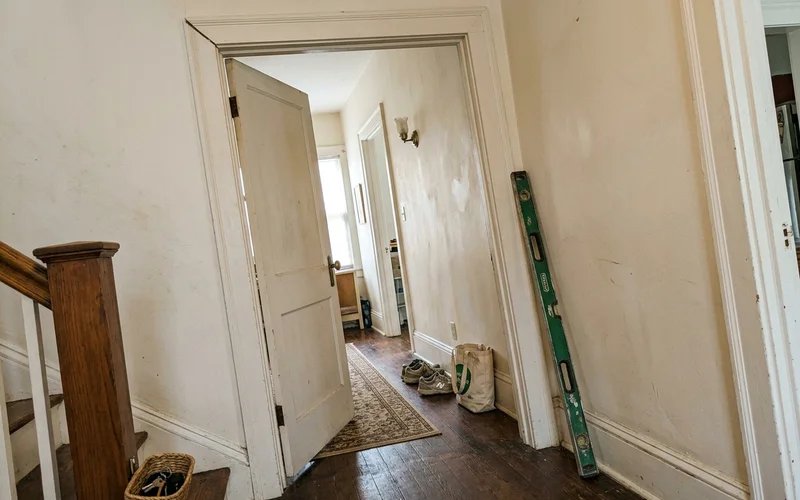
Moving inside, sticking doors and windows provide the next set of clues. Every opening in your house was perfectly square when the builders framed it.
We know that when a footing drops, the framing racks, the opening shifts out of square, and the hardware starts binding on one corner. Many homeowners blame humidity first, which makes sense in our wet climate.
Summer humidity swells a wooden door evenly on all sides. Our team notes that if you have sticking doors, foundation settlement binds the frame in one single corner and leaves a highly visible, tapered gap on the opposite side. This tapered gap is the dead giveaway that the floor below has dropped.
The quarter test
Set a coin on its edge on your floor. If it rolls consistently in the same direction in several rooms, you have a slope, not a soft spot. Combine that with cracks at the same end of the house and you have a pattern worth measuring.
Why Georgia Soil Causes This
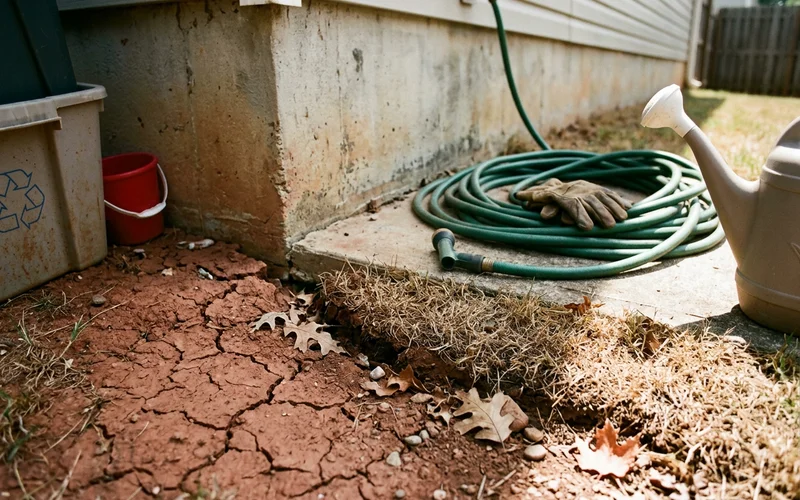
Expansive Piedmont red clay is the primary reason structural repair is a bigger industry here than in most of the country. This specific soil type, officially classified as an Ultisol, is rich in an expansive mineral called kaolinite.
We see this soil absorb massive amounts of water and physically swell during our wet spring months. A saturated yard in North Georgia can actually swell by 10 to 15 percent in volume.
Our technicians watch the ground release that water and shrink dramatically during a dry summer stretch. The clay often pulls visibly away from the foundation wall, leaving a deep gap you can drop a tape measure into.
The Problem of Differential Settlement
Nature never applies this soil pressure evenly across your property. We constantly see a few specific environmental factors driving this imbalance:
- Sun exposure: The shaded north side stays damp while the sunny south side bakes into hardpan.
- Poor drainage: A single misplaced downspout dumps concentrated water at one corner.
- Large vegetation: A mature oak tree pulls massive amounts of moisture out of the soil on one side of the yard.
Our localized assessments show that these factors cause one part of the foundation to ride higher or lower than the rest. The rigid structure above has to absorb that extreme difference. We use the term differential settlement to describe this uneven movement.
This cycle explains why the timing of your damage matters so much. Cracks often appear or widen at the end of a dry summer, then seem to close slightly after the fall rains arrive.
Many homeowners take that temporary closing as reassurance. Our experts view this as absolute confirmation that your home is resting on unstable ground. Any structure moving with the seasons will eventually suffer permanent stress.
What Is Urgent and What Can Wait
You need to know how to prioritize the damage you find during an inspection. We recommend booking a professional evaluation immediately if you spot active structural movement.
Structural Emergencies vs. Cosmetic Flaws
Active structural failure requires fast intervention to prevent a collapse. Our crews consider the following signs to be urgent emergencies:
- A horizontal crack in a block wall or a wall visibly bowing inward.
- A vertical crack wide enough to fit a standard pencil into.
- Exterior brickwork that has shifted out of plane or separated from windows.
- A severe floor slope you can clearly see without using a level.
You should simply monitor the situation if you find thin vertical cracks in poured concrete with zero displacement. We also advise homeowners to keep an eye on small drywall cracks at the corners of openings, or a single door that sticks only in August.
Many of these turn out to be non-structural shrinkage. when crack sealing is enough walks through exactly how that call gets made in the field.
The True Cost of Delaying Repairs
The honest reason to have a professional look early comes down to basic math and recent 2026 market rates. Our data shows that average Atlanta foundation repairs generally run between $4,500 and $12,000.
Stabilizing a structure while the movement is still measured in fractions of an inch is a highly targeted, affordable job. We utilize a few specific methods to halt movement before the damage spreads. The table below outlines the typical costs and applications for early intervention:
| Repair Method | Best Used For | 2026 Average Atlanta Cost |
|---|---|---|
| Carbon Fiber Strips | Bowing basement walls with minimal deflection | $750 - $1,200 per placement |
| Helical Piers | Settling footings requiring deep stabilization | $1,400 - $1,600 per pier |
| Polyurethane Injection | Lifting sunken interior concrete slabs | $550 - $1,300 per area |
Waiting until the brick has to be rebuilt, the framing reworked, and the interior finishes replaced turns one single trade into four. Our estimators see delayed action push comprehensive repair bills past $20,000 rapidly.
An inspection gives you hard data instead of daily worry. We map the floor elevations across the entire house, measure wall deflection against a straight line, and take deep moisture readings at the footings. The process ends either with a concrete repair plan or with permission to stop thinking about it.
Secure Your Foundation Today
Your home is your largest investment, and protecting its structural integrity is critical. We know that dealing with Georgia red clay can feel overwhelming, but you do not have to figure it out alone.
Catching these warning signs early is the absolute best way to save money.
Contact Basement Waterproofing Atlanta today to schedule your free, comprehensive structural inspection. We will provide you with clear answers, honest pricing, and a permanent solution to keep your home standing strong.